PERIOPERATIVE PHYSIOLOGY

Cumulative exposure.
Recent history.

A research window into how charted intraoperative physiology updates postoperative mortality risk.

Developed in INSPIRE Frozen evaluation in MOVER

Try the interactive model
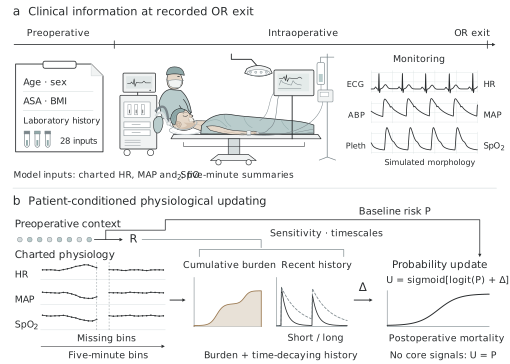
Graphical abstract: preoperative clinical context and charted HR, MAP and SpO₂ feed cumulative burden and time-decaying history to update risk at recorded OR exit. Monitoring waveforms illustrate simulated morphology.
Graphical abstract
View full size PDF

INTERACTIVE MODEL

Explore a physiological update

01

Preoperative context

Enter available values. Leave unavailable fields blank.

Use the recorded band, in years.
Laboratory history 7 optional tests

Use measurements collected 24–720 hours before the preoperative cutoff (the earlier of anaesthesia start and OR entry). Enter the measurement lag alongside each value.

Test & unitValueLag, hours
02

Intraoperative observations

Charted measurements, in minutes from OR entry.

One harmonised measurement per channel and time. Blank cells stay missing; an empty series tests the preoperative-only fallback.
How observations become model inputs

Observations from minute 5 through five minutes before OR exit are grouped into five-minute bins. Exact time/value duplicates are removed before taking medians. Missing bins are retained. HR 10–250 bpm, MAP 15–200 mmHg and SpO₂ 20–100% are accepted. Supply a harmonised series after choosing a measurement source; this form does not merge raw hospital chart vocabularies.

03

Calculate locally

The small model loads automatically. Calculate whenever your inputs are ready.

Inputs stay in this browser tab.
Model: ~117 KB compressed · reused for later calculations.

Loading the model…

THE METHOD

From charted physiology
to a risk update.

Preoperative information establishes the starting probability. Five-minute summaries of HR, MAP and SpO₂ feed cumulative exposure and time-decaying history states, with sensitivity and timescales conditioned on patient context.

The source-developed model and calibration remain frozen. Three pipelines, each with four physiological readouts, run locally; their probabilities are averaged. With no core observations, the physiological estimate exactly equals the preoperative probability.